From Food Waste to Design Resource
10-08-2026Under business-as-usual scenarios, it has been projected that by 2050 there could be more plastic than fish (by weight) in the world’s oceans (1.) highlighting the urgent need for new material management strategies. Designers and material researchers are increasingly looking for alternatives to conventional petroleum-based products. Despite advances in mechanical and chemical recycling technologies, recycling remains constrained by technical, economic, and material limitations, preventing plastics from being effectively retained within a circular economy (2.).
Not a long time ago, biodegradable polymers such as polylactic acid (PLA) emerged as one promising alternative. Widely used in additive manufacturing, PLA can be processed through low-energy fabrication methods such as Fused Deposition Modelling (FDM), making it suitable for a wide range of applications, from packaging and consumer products to public infrastructure. However, PLA production still largely depends on agricultural feedstocks such as corn, raising concerns about land use and broader environmental impacts (3.).
As a result, growing attention is being directed towards composite materials that combine PLA with waste-derived additives, with the aim of reducing the overall pollution. One particularly promising material comes from aquaculture and the seafood industry, called calcium carbonate (CaCO₃).
Mussel shells are primarily composed of calcium carbonate, a naturally occurring mineral known for its structural properties and widespread use in construction and manufacturing. During their growth, mussels absorb carbon dioxide from the surrounding marine environment and convert dissolved carbon into calcium carbonate through a biomineralization process, gradually building their shells layer by layer. As a result, each shell functions as a small carbon reservoir, accumulating material over the lifespan of the organism. Despite these qualities, shell waste generated by the seafood industry is often landfilled or otherwise discarded, leaving its material and environmental potential underutilized. However, recent research has shown that incorporating shell-derived calcium carbonate into PLA can improve material properties while contributing to waste valorisation. The presence of inorganic shell-derived fillers may also promote material disintegration, which can facilitate subsequent biodegradation under appropriate conditions (4.).
Moreover, beyond their technical performance, mussel shells present a unique opportunity for circular design. By reusing mussel shells after consumption, the carbon stored during the mussels’ growth remains trapped within new products for longer. Instead of becoming waste, the shells gain a second life as a valuable material. This approach extends the lifespan of both the material and the carbon it contains, while reducing waste and the need for new resources. In this way, mussel shells become a resource that carries both environmental and material value.
Project link:
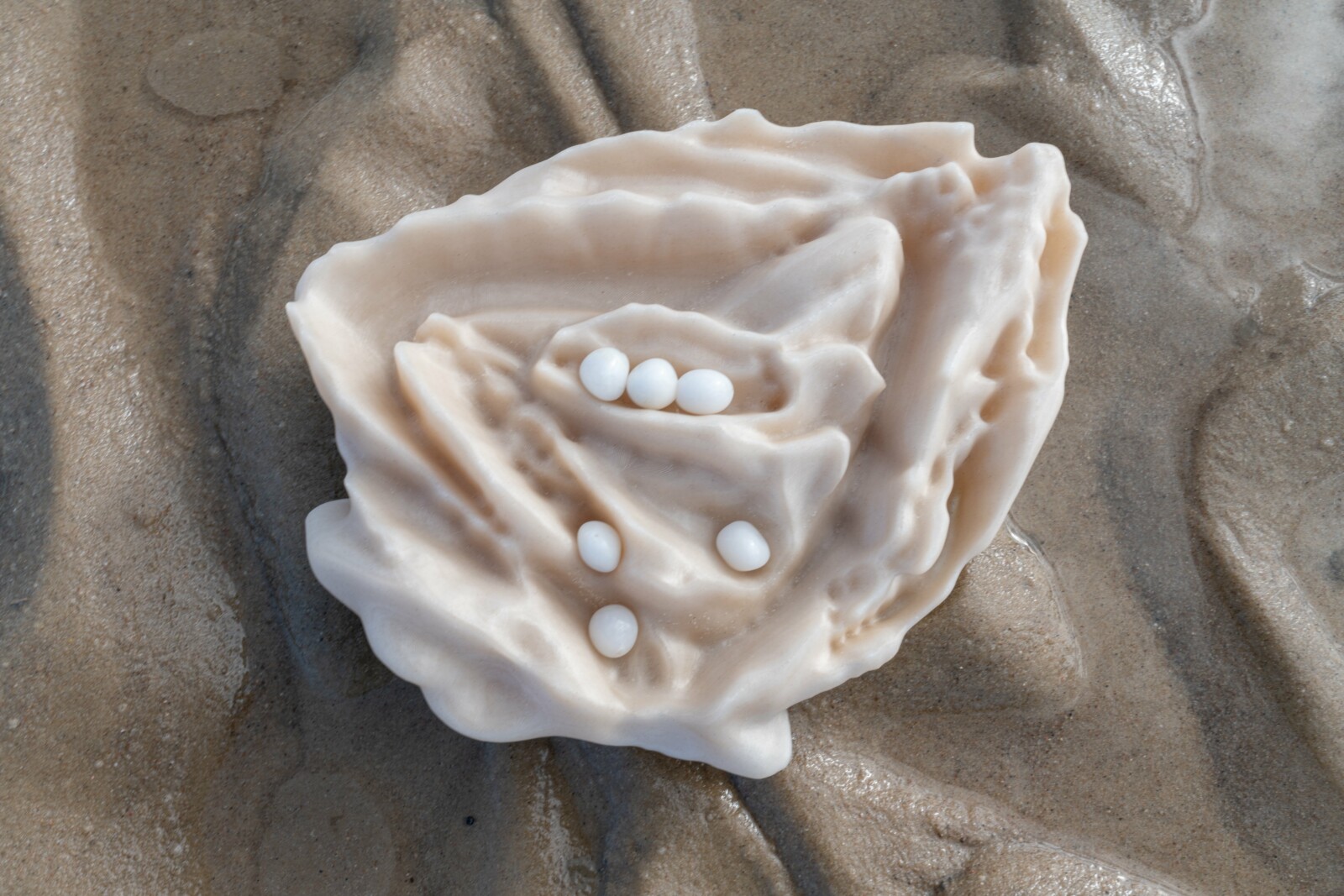
These ideas formed the basis of Your Personal Carbon Storage (YPCS) by Nataly Khadziakova and Katya Bryskina, a series of computationally designed and 3D-printed objects developed between 2022 and 2023. Produced using PLA containing powdered mussel shells, the project investigates how material circularity can be translated into tangible artefacts which would be a reminder of their environmental impact. The objects function as small containers for personal belongings, like jewellery, while simultaneously acting as repositories of captured carbon and transformed biological waste.
The same approach has been extended in a new series of artworks produced by Giles Miller Studio, where mussel-based PLA has been used to fabricate bespoke components for large-scale sensory artworks. Integrating shell-derived biocomposite into computational design and digital fabrication workflows, the project explores how waste materials can become part of expressive architectural surfaces. Beyond reducing reliance on virgin plastics, the work demonstrates how sustainable materials can contribute to new aesthetic and tactile qualities, embedding environmental narratives directly into public art.
Those projects demonstrate that by transforming discarded mussel shells into a component of contemporary fabrication processes, waste can be redefined as a resource. The shells carry a trace of their environmental history, including the carbon stored during their growth.Therefore, each object becomes a physical representation of a circular system, linking aquaculture, consumption, waste recovery, and design.
As the design disciplines continue to engage with questions of sustainability and resource scarcity, biological waste streams such as mussel shells offer opportunities to rethink conventional material hierarchies. Projects like those described suggest that circular design is not only a technical challenge but also a cultural one. Through material experimentation and design practice, waste can be reimagined as a carrier of both environmental and aesthetic significance, opening new pathways for more regenerative forms of production.