Can Art be good for the Soul?
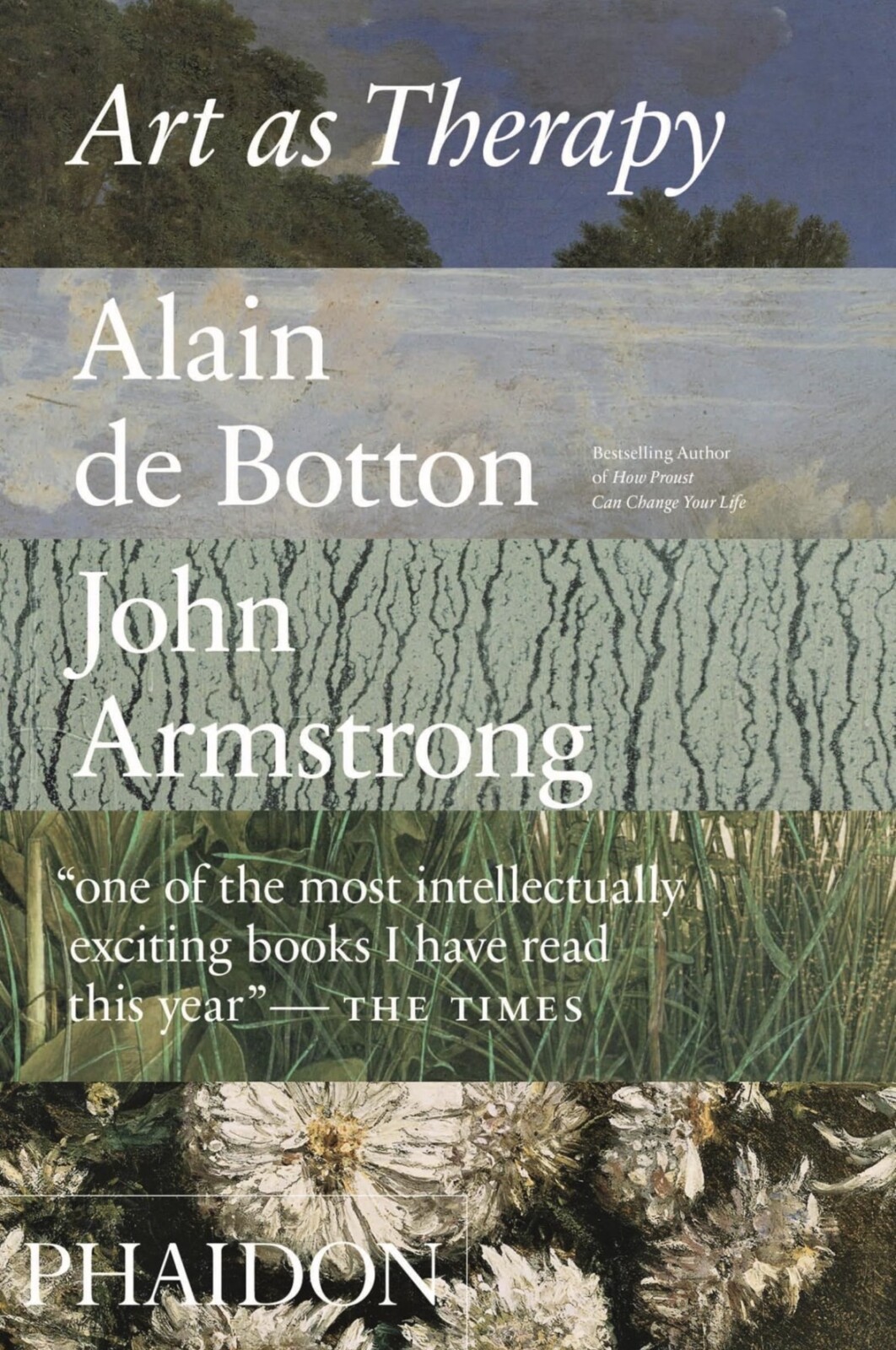
05-04-2026Source: Art as Therapy (2013) by Alain de Botton and John Armstrong. Published by Phaidon Press.
“We need art because we are forgetful. We forget what matters to us, we forget what we love, we forget what we are striving for. Works of art can act as reminders, storing and then recalling the best parts of ourselves. They can hold before us what we are in danger of losing.”
– de Botton & Armstrong, Art as Therapy (2013)
Alain de Botton and John Armstrong fundamentally question arts traditional definition.
Rather than valuing artworks for their status, rarity, or critical position, they propose a more human and urgent metric: how does art help us live?
Their argument reframes art as a psychological tool – something that can stabilise us, reconnect us to what matters, and gently guide our emotional states. In this sense, art is not passive or decorative, but active: it works on us. It reminds, restores, and rebalances.
A central thread in the book is the idea that art can function as a form of remembering – particularly remembering our relationship with nature. In modern life, much of what sustains us psychologically has been pushed to the margins: open landscapes, organic complexity, shifting light, and the quiet rhythms of the natural world. We spend increasing amounts of time in controlled, artificial environments that prioritise efficiency over emotional nourishment. In this context, art takes on an important compensatory role.
De Botton and Armstrong suggest that artworks can reintroduce us to these lost qualities. A painting of a landscape, the play of light across a textured surface, or the repetition of organic patterns can act as a surrogate for direct experience – not replacing nature, but reminding us of its presence and importance. These visual cues can gently recalibrate the mind, offering moments of calm, perspective, and emotional grounding.
This is not simply symbolic. The therapeutic effect lies in the felt experience of the work. Natural references – whether explicit or abstracted – tend to operate on an intuitive level. Fractal-like patterns, soft gradients, irregular rhythms, and material richness mirror the visual language of the natural world, which humans are evolutionarily attuned to process with ease. When encountered in art, these qualities can reduce cognitive strain and invite a slower, more reflective mode of attention.
In this sense, artworks become carriers of environmental memory. They hold onto something we risk losing in the pace and pressure of contemporary life, and re-present it in a form we can access daily. A surface that shifts with light, a composition that suggests growth or movement, or a material that feels inherently grounded can all act as subtle reminders of a more balanced state of being.
This perspective aligns closely with research in neuroaesthetics and environmental psychology, which suggests that exposure to nature-referencing visual stimuli – even in abstracted forms – can lower stress levels, improve mood, and support cognitive restoration. Art, therefore, becomes part of a wider ecosystem of wellbeing, working alongside natural light, planting, and spatial design to shape how we feel within a space.
What Art as Therapy ultimately offers is a shift in emphasis: from asking whether art is important, to asking whether it is beneficial. And in doing so, it opens up a more generous understanding of art’s purpose – not as a marker of taste, but as a quiet, continuous support to human health and happiness.
A wonderful read at a time when our studios practice is learning so much about the depth of our own artistic practices impact.
Also highly recommended is The Architecture of Happiness (2006) by Alain de Botton, which is essentially the architectural counterpart to Art as Therapy. Instead of focusing on artworks, it explores how buildings and environments affect our emotional lives, and it was inspirational during the conception and development of Woven, our residential building-come-sculptural space in Broadstairs, Kent.