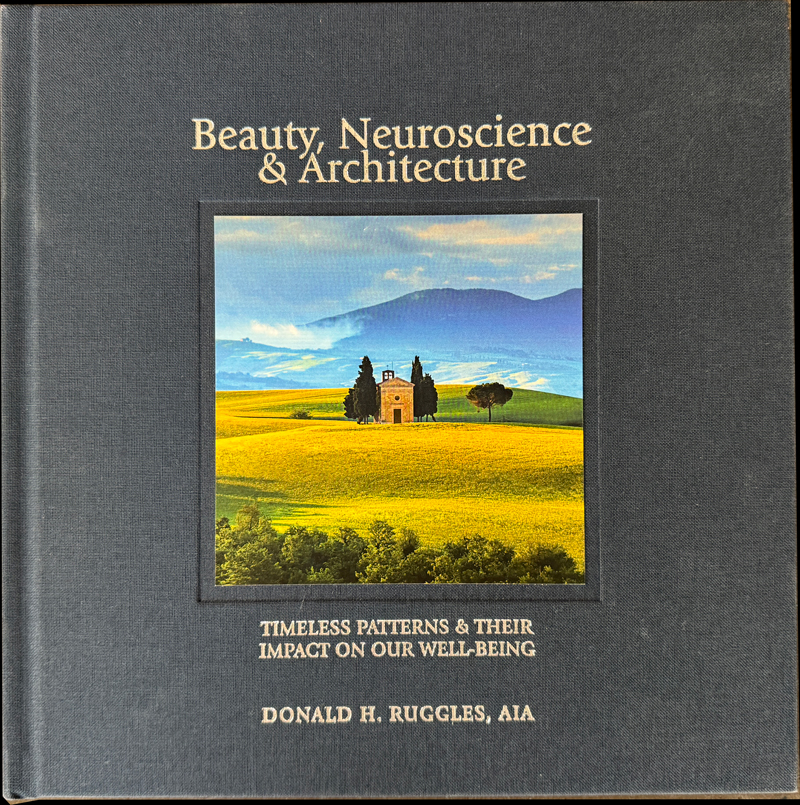
Beauty, Neuroscience and Architecture by Donald H Ruggles
01-10-2025“Beauty is one of the most important emotions in life.
Beauty can save the world, one person at a time.
I am sure of that.”
Renzo Piano, Charlie Rose Interview, Spring 2017
Extracts from Donald H Ruggles book, Beauty, Neuroscience and Architecture.
Ruggles investigates the bridge between beauty and human emotion within architecture, and speaks to the evolution and fundamental importance of the impact of beauty on the human psyche. The book is published by Fibonacci LLC and is distributed by University of Oklahoma Press.
“Have you ever been in a room that you didn’t want to leave? Was it a space that calmed you, made you feel whole, nourished, hopeful? Have you known a building or a piece of art that you went out of your way to engage with on a routine basis?
Or conversely, have you experienced a room that is unsettling, one that overwhelms the senses to the point of discomfort? Did you sense you had to leave as quickly as possible?
A more general question is, are we subconsciously aware of buildings that we routinely approach or avoid? This is the power of architecture and design at work, and neuroscience is unlocking the ideas of art and architecture that have such an effect on us, whether positive or negative, and why they do.
In roughly 400 B.C., Plato wrote that the three ultimate values were truth, goodness and beauty. Vitruvius wrote in the first century B.C. that the three fundamental components to architecture were strength, utility and beauty. Then in the 16th century, Andrea Palladio wrote that the three essentials were firmness, commodity and delight. Ail were masters that worked hundreds of years apart, agreeing that there are three basic qualities of a successful building: structure (form), program (use) and aesthetics (beauty).”
“I am pondering a concept I recently had read in “The Aesthetic Brain” by Anjan Chatterjee. The author explores the Pleistocene epoch, a period beginning some 2.4 million years ago. This is when the evolution of modern humans took shape. In particular, he describes how during this period, humankind came to associate the image of an open savanna with something bountiful, safe and habitable. Over time, knowing their offspring would thrive in this environment, the sight of such an open space and the recognition of the pattern associated with the savanna immediately would trigger physical relief in early humans.
Chatterjee, based on a 1992 paper written by Gordon Orians and Judith Heerwagen, asserts that the visual image of an open savanna creates a physical signal that became associated with survival and modulated subconscious human biology accordingly. Through the millennia, this reaction to the patterns imbedded in the savanna-scape became intuitive and influenced the neuronal growth of the primitive brain, effectively encoding intuitive reaction into our genetics.
I soon discovered there is extensive research to support the notion that people have multiple, subconscious tendencies toward their environment. Whether positive and supportive or negative and stressful, they are always intuitive.”
“When we view a pattern that has the promise of beauty, it activates our curiosity and we turn our gaze to take a closer look. The parasympathetic nervous system then alerts the cortex that a pattern is in our view that registers in our limbic brain as safe and pleasurable. The curiosity leads to anticipation, which is followed by a release of endorphins. The feeling of pleasure is the reward from the endorphins. The result: the proclamation, “It’s beautiful.” This leads to another cycle. Curiosity is activated even more, which leads to more anticipation, which is followed by pleasure, which initiates the proclamation “absolutely beautiful.” And on and on the cycle goes. The more profound the pattern, the more curiosity and the more pleasurable the experience.”